
Assessment: My Child Needs Help! How Should I Get Started with Mental Health Care?

Assessment: My Child Needs Help! How Should I Get Started with Mental Health Care?


Assessment: My Child Needs Help! How Should I Get Started with Mental Health Care?

Noticing that your child is beginning to struggle with their mental and behavioral health can be a hard moment for any caregiver. The challenges that your child is facing may have begun slowly and grown over time, or may have seemed to come up abruptly, with no easy cause or event to blame. It can be paralyzing to watch your child suffer, and to feel the impact on your own family and home, without knowing the next steps you need to take to secure effective support.   The National Center is helping States, Tribes, and territories improve access to child welfare competent mental health services. As part of our efforts to support child-serving systems, we’ve partnered with the Baker Center to create this evidence-based assessment guide to help families and caregivers find care for their loved ones.   There are many kinds of assessments that address different presenting problems and challenges, so let’s break it down to help you identify the assessment that you might need for your child. These different assessments can be useful in their own ways, but it can be overwhelming to figure out the right fit.     

Adoption Competent Assessments 

Mental health professionals working with children and families who have experienced the child welfare system should ensure that their assessment addresses this unique experience. The assessment process should be used as an opportunity to provide families feedback and psychoeducation to help them shift from blaming the child or themselves to a more realistic understanding of what has happened to the child and the resulting difficulties. Some commonly used assessment measures are:  Achenbach System of Empirically Based Assessment  Includes the Child Behavior Checklist and Youth Self Report  The Child and Adolescent Needs and Strengths (CANS)  Parenting Stress Index  Treatment Outcome Package    This article provides more information about how adoption competent assessments can increase the effectiveness of mental health services.  

Neuropsychological Assessments 

Neuropsychological assessments are conducted by neuropsychologists, who are specifically trained to carry out testing procedures and understand the relationship between an individual’s behavior and cognition. These evaluations are appropriate for children at least 6 years old, through adulthood, though some evaluations may occur much earlier depending on a child’s presentation and need. A good neuropsychological assessment will start with a referral question and then the neuropsychologist works to identify psychological tests that will help them answer pertinent questions. These questions can be broad and are determined by an individual’s need. For instance, a neuropsychological evaluation can assess questions of intelligence, lea ing and comprehension, reading abilities, language abilities, concentration, attention, processing speed, memory, fine motor skills, visuospatial skills, executive functioning, and mood/personality.    This kind of testing is often recommended when an individual is experiencing unexplained challenges in day-to-day functioning, particularly struggles at school. This could include difficulty with lea ing and encoding new information, short term memory, challenges interacting with and communicating with others, speaking or pronunciation challenges, poor attention and concentration, unexplained changes in personality, major challenges with executive functioning skills, and having trouble staying organized or completing tasks, among other things. Neuropsychological evaluations can help identify things like: 

  • Learning Disabilities 
  • Neurodevelopmental Disorders 
  • ADHD 
  • Autism 
  • Cognitive difficulties 
  • Mood Disorders 
  • A developmental delay 

  The result of a neuropsychological evaluation is the identification of the above challenges, and recommendations for next steps to support your child through additional services or support in school.  

Diagnostic Assessments 

If you know your child or teen is struggling, but you’re not totally sure why and they haven’t yet received a psychological evaluation, a diagnostic assessment is a good place to start. A diagnostic evaluation involves a semi-structured interview process in which children and their caregivers are asked about an array of diagnostic areas they might struggle with and specific examples from the child or teens life about how these challenges manifest across settings. The interview will address cultural, social, emotional, behavioral, and mental health conce s for children and adolescents across a wide spectrum. The clinician will address challenges including mood disorders, behavioral disorders, executive functioning, and traumatic stress to consider a broad etiology of factors contributing to the presenting challenges, especially because in youth mental health, the culprit is rarely the cause.  In addition to a semi-structured interview, good diagnostic assessments will also include the completion of clinical questionnaires to corroborate or provide an alte ative perspective on functional impairments across settings. This includes having the youth, their caregivers, and other important adults in their lives (e.g., teachers, coaches), completing validated questionnaires about how symptoms do or do not present. Once the interview with child and caregivers are completed and questionnaires are scored, the assessing clinician will hold a feedback session, often complemented with a diagnostic report, outlining clear diagnostic impressions and recommendations for next steps, including treatment and other resources for support.    Examples of diagnostic assessments that are validated and empirically supported are: 

  • The K-SADS, (Kiddie Schedule for Affective Disorders and Schizophrenia) 
  • The ADIS (Anxiety Disorder Interview Schedule) 
  • DIAMOND (Diagnostic Interview for Anxiety, Mood, and OCD and Related Neuropsychiatric Disorders) 
  • TheMINI (Mini International Neuropsychological Interview) 

  Bottom line, a good diagnostic assessment is a good place to start, and should include an interview, questionnaires, and a feedback session to clearly outline the problem and the next steps to address it.  

ADOS  

For more specific areas of concern, there are specific types of evaluations and tests that you can request to help you answer the questions you have about your child. If Autism Spectrum Disorder is an area of conce , we recommend seeking out a provider who offers ADOS. The Autism Diagnostic Observation Schedule-Second Edition (ADOS-2) is an assessment administered by professionally trained clinicians to evaluate conce s specifically related to Autism Spectrum Disorder. In the evaluation, they will be assessing communication skills, social interaction abilities, and imaginative uses of materials. This assessment is appropriate for kids as young as 12 months into adulthood and, in tandem with the Autism Diagnostic Interview (ADI) or another comprehensive developmental interview, is considered the gold standard for how to evaluate and diagnose autism across the lifespan. We know that early and comprehensive diagnosis for neurodevelopmental conce s such as autism are key to successful treatment and prevention of problems getting worse over time. Therefore, families must be empowered with information on how to assess this conce . A good autism evaluation should consider developmental history, information from informants in the child’s life, and behavioral observations across time and settings.   When you’re deciding where to pursue your evaluation, it’s important to consider what you hope to gain from the assessment. Each of these types of evaluations can provide valuable insight, but you want to make sure that it’s shining a light on the challenges that are most prominent for your child, and that any diagnoses or recommendations given can be actioned based on the information from the assessment.   

Sources   

Ardila A, Ostrosky F. What do neuropsychological tests assess? (https://pubmed.ncbi.nlm.nih.gov/31826667/) Appl Neuropsychol Adult. 2022;29(1):1-9. Accessed 07/08/2024.  

Casaletto KB, Heaton RK. Neuropsychological Assessment: Past and Future (https://pubmed.ncbi.nlm.nih.gov/29198281/). J Int Neuropsychol Soc. 2017;23(9-10):778-790. Accessed 07/08/2024.  

Kaufman, Joan, et al. “Schedule for affective disorders and schizophrenia for school-age children-present and Lifetime version (K-SADS-PL): Initial reliability and Validity Data.” Jou al of the American Academy of Child & Adolescent Psychiatry, vol. 36, no. 7, July 1997, pp. 980–988, https://doi.org/10.1097/00004583-199707000-00021 

McCrimmon, A., & Rostad, K. (2014). Test Review: Autism Diagnostic Observation Schedule, Second Edition (ADOS-2) Manual (Part II): Toddler Module. Jou al of Psychoeducational Assessment, 32(1), 88-92. https://doi.org/10.1177/0734282913490916  

Sheehan, D. V., Lecrubier, Y., Sheehan, K. H., Amorim, P., Janavs, J., Weiller, E., Hergueta, T., Baker, R., & Dunbar, G. C. (1998). The Mini-Inte ational Neuropsychiatric Interview (M.I.N.I.): the development and validation of a structured diagnostic psychiatric interview for DSM-IV and ICD-10. The Jou al of clinical psychiatry, 59 Suppl 20, 22–57.  

Shulman, Cory, et al. “The role of diagnostic instruments in dual and differential diagnosis in autism spectrum disorder across the lifespan.” Child and Adolescent Psychiatric Clinics of North America, vol. 29, no. 2, Apr. 2020, pp. 275–299, https://doi.org/10.1016/j.chc.2020.01.002 

Simon, Ellin, and Susan Maria Bögels. “Screening for anxiety disorders in children.” European Child & Adolescent Psychiatry, vol. 18, no. 10, 5 May 2009, pp. 625–634, https://doi.org/10.1007/s00787-009-0023-x.   

Tolin, D. F., Sain, K. S., Davis, E., Gilliam, C., Hannan, S. E., Springer, K. S., Stubbing, J., George, J. R., Jean, A., Goldblum, R., Katz, B. W., Everhardt, K., Darrow, S., Ohr, E. E., Young, M. E., & Serchuk, M. D. (2023). The DIAMOND-KID: Psychometric Properties of a Structured      Diagnostic Interview for DSM-5 Anxiety, Mood, and Obsessive-Compulsive and Related Disorders in Children and Adolescents. Assessment, 30(8), 2351-2363.  https://doi.org/10.1177/10731911221143994 

Looking for Additional Resources?

Visit the Knowledge Hub to access models of intervention, training resources, and practical tools to strengthen cross-system collaboration and improve outcomes for children, youth, and families. 

This Week in the News 9/30-10/4

This Week in the News 9/30-10/4


This Week in the News 9/30 – 10/4

This month, the National Center is highlighting ways to improve access to child welfare competent mental health services across States, Tribal Nations, and territories. Our Intensive Technical Assistance services are designed to support these efforts by offering tailored solutions that address the complexities of these systems. In this week’s news, we’ve gathered key examples of how both State and Federal agencies are leading the way in improving access to these critical services. These stories underscore the multi-faceted strategies required to ensure children and families receive the care they need.   

AAP applauds new CMS guidance to improve comprehensive health care for children in Medicaid, CHIP | AAP News | American Academy of Pediatrics  The Centers for Medicare & Medicaid Services (CMS) has issued new guidance aimed at improving pediatric care, with a particular focus on children with specialized needs such as those with mental health conditions, in foster care, or with disabilities and complex health needs. The guidance outlines key components of a high-functioning care system, including a single point of entry, integrating support for mild to moderate needs within primary care, and ensuring access to a broad range of community-based specialty care. It also emphasizes limiting inpatient mental health treatment to situations where it’s medically necessary. To strengthen the pediatric workforce, CMS recommends strategies like improving compensation to attract providers, expanding provider qualifications, utilizing telehealth, using interprofessional consultations to access specialty providers, and reducing administrative barriers like prior authorizations.   

How WA is trying to get kids in mental crisis out of hospitals | The Seattle Times  The Seattle Times Mental Health Project is investigating the day and week-long waiting periods children face for vital psychiatric care. This article speaks with Taku Mineshita, a recent hire to a new position that will oversee the agencies responsible for care for children. Mineshita plans to employ cross-system collaboration to simplify the process of accessing services for families and addressing children’s needs before they reach a crisis point.    

State Agencies Announce Effort to Support Children with High Acuity Needs  The Indiana Gove or has created a Children with High Acuity Needs Project which brings together The Family and Social Services Administration the Department of Correction, the Department of Child Services, and the Department of Education to provide more support to children with high acuity mental and behavioral health needs and keep youth in crisis in the least restrictive setting possible. The four goals of the project are: 

  • Cross-agency navigators: These will help coordinate care across various services, including education, mental health, child welfare, and juvenile justice, using schools as a hub to prevent institutionalization and help children transition back home from residential settings. 
  • Support for foster parents and kinship caregivers: Caregivers will receive extra support for caring for children with high needs, including access to respite care. 
  • Gatekeeper process review: A system to ensure children in the state’s psychiatric hospital network remain in the least restrictive setting and can leave as soon as they are ready, preventing unnecessary extended stays. 
  • Youth transitional homes and caregiver coaching: Transitional homes will offer short-term support for children leaving residential care to help them reintegrate into their communities, while families receive caregiver coaching to assist with the transition. These homes are designed for short-term use, unlike traditional group homes. 

  Intensive kids’ mental health treatment program opens north of Salem – Salem Reporter  The Meadowlark Program in Salem Oregon was created to meet students’ mental health needs and ensure that they do not fall behind in their education so that they can retu to their home school.     

Study reveals impact of adverse childhood experiences on teen mental health (news-medical.net)  Another step to improving access to mental health services is to have a better understanding of risk factors so services can be implemented to support children and families earlier.  A 15-year University of Michigan study reveals that teens who faced high emotional and multidimensional adversity early in life are at the greatest risk for mental health challenges. Tracking over 4,000 youths from birth to age 15, the study explored how adversities such as maltreatment, family violence, and maternal depression impact mental health and brain function. Key findings include: 

  • Teens exposed to high adversity across multiple contexts (home, family, neighborhood) show worse mental health outcomes and differences in brain activity related to emotion processing. 
  • Maternal depression alone can lead to significant negative effects, even when other adversities are moderate.
Webinar: Deep Dive Into Intensive Technical Assistance

Webinar: Deep Dive Into Intensive Technical Assistance


WEBINAR:

Deep Dive Into Intensive Technical Assistance

Learn how Intensive TA can help systems increase access to child welfare competent mental health services for children and families.

We are eager to talk with you about the intensive technical assistance (TA) we can offer your State, Tribe, or territory. TA involves communication between a specialist and an organization to implement and sustain change. Our TA services are collaborative, systematic, targeted, adaptive, customized, and results-driven. We will partner closely with your child welfare and mental health systems and will work with you to create or expand cross-system collaboration to help systems increase access to child welfare competent mental health services for children and families. Our TA team will work together with each TA site to develop a custom implementation plan that is tailored and responsive to the site’s unique needs, strengths, and structure.


Webinar: Deep Dive Into Intensive Technical Assistance
Presented: October 15, 2024

Watch webinar

Webinar Speakers

Michelle Savieo, MSW
Director of TA – The National Center

Sean E. Snyder, DPA, MSW, LCSW
Site Director & Associate Director of Implementation 

Michelle Seymore

Michelle Seymore
National Director of Partnerships

Oklahoma Hears from Lived Experience Leaders About Improving Mental & Behavioral Health

Oklahoma Hears from Lived Experience Leaders About Improving Mental & Behavioral Health

Oklahoma Hears from Lived Experience Leaders About Improving Mental & Behavioral Health

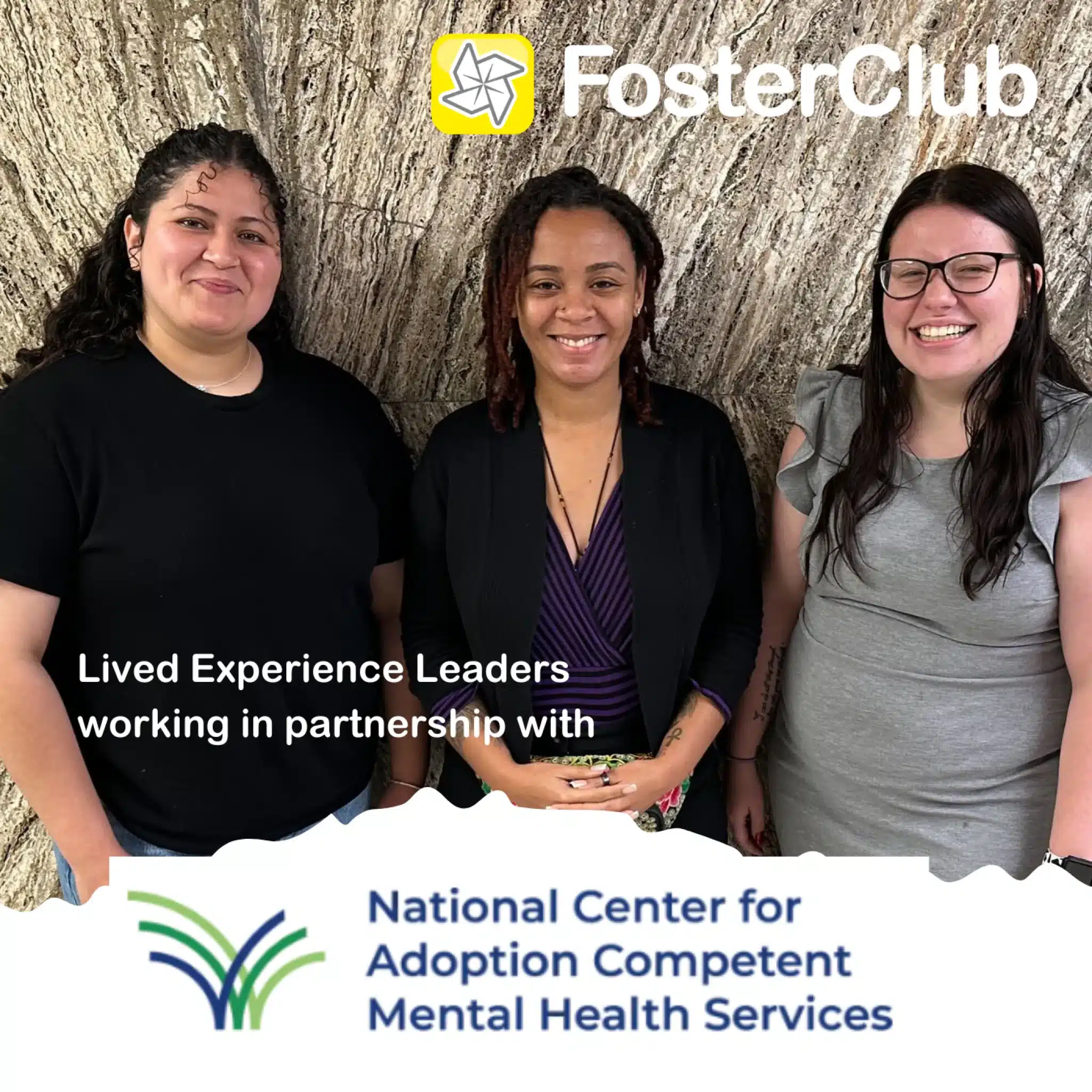
On September 19, FosterClub Lived Experience Leaders Cinthia Garcia, age 22 (Indiana), Anaya Carter, age 24 (Texas), and Kenzie Drake, age 20 (Missouri), shown left to right, went to Oklahoma with The National Center for Adoption Competent Mental Health Services to talk about challenges and solutions for improving mental health and behavioral health for young people in foster care. Cinthia, Anaya, and Kenzie are members of the Lived Experience Advisory Board, a ten-member team of young people with lived experience in the child welfare system designed to advise the National Center and its partners in its work over a five year project.

The National Center aims to improve mental health outcomes for children and families impacted by child welfare by providing technical assistance that bridges the gap between child welfare and mental health systems. The National Center prioritizes the need for specialized mental health services for children and families who have experienced the child welfare system.

The Advisory Board is managed by FosterClub, the national network for young people in foster care, a partner of the National Center. Oklahoma is the first site of the National Center. The meeting brought together mental health and behavioral health practitioners with child welfare leaders to discuss challenges and solutions in serving children, youth, and their families. Get to know the three LEx Leaders who participated:

Cinthia Garcia (She/Her), age 22 Spent 5 years in Indiana foster care Cinthia Garcia, originally from Mexico, entered the foster care system at 16 and aged out at 21. Overcoming challenges like language barriers and financial instability, she is now pursuing a degree in Spanish. Cinthia has been recognized for her advocacy work, including being named Outstanding Youth Advocate in 2024.  Cinthia is passionate about continuing her education, with long-term goals of ea ing a Master’s in Social Work.

Anaya Carter (She/Her), age 24 Spent 3 years in Texas foster care Anaya Carter, from Texas, is a spiritual healer and advocate with three years of foster care experience. After aging out at 18, she found healing through the Texas Network of Youth Services, where she serves on the Young Adult Leadership Council. Anaya is passionate about helping others heal from trauma and is proud of her personal and spiritual growth. She works in childcare and supports her brother’s child development franchise. Anaya is excited to continue her advocacy work with FosterClub, aiming to be a leader and voice for youth across the nation.

Kenzie Drake (She/Her), age 20 Experience in Missouri foster care Kenzie is currently in college pursuing her passion of nursing and anticipates graduating in 2026. When she’s not studying, Kenzie loves to walk and hang out with friends. One thing she is extremely proud of is graduating high school with a 3.9 GPA. Currently, Kenzie could work at a hospital as a Nursing assistant. She wanted to be a part of FosterClub to use her lived experience to support youth who are enduring a broken system.

This Week in the News 9/3-9/10

This Week in the News 9/3-9/10


This Week in the News 9/3-9/10

We are focused on suicide prevention this month and the National Center is committed to being part of the solution.  Talking openly about suicide is prevention within itself. We pulled some headlines that we felt contribute to the dialogue about suicide prevention in child welfare.   

This article from Youth Villages highlights the critical role of building connections in supporting mental health and preventing suicide. The author emphasizes that strong, supportive relationships are essential for individuals struggling with mental health issues. Read about strategies for fostering these connections, such as creating safe spaces for open communication and offering consistent support. By strengthening social bonds and promoting a sense of belonging, individuals are better equipped to handle mental health challenges and reduce the risk of suicide.    Our hope is that children and youth receive mental health support when it’s needed so we can minimize them reaching a crisis level. A few States have created programs to better meet the mental health needs of children.   

North Carolina has created a new child treatment program aimed at improving mental health support for children. The program, launched in response to growing conce s about mental health among young people, focuses on providing comprehensive care that includes therapy, counseling, and family support. This initiative seeks to address the rising need for specialized mental health services and aims to offer more accessible and effective treatment options for children and their families in the state.    A new children’s psychiatric treatment center has opened in Hamden, Connecticut. This facility is designed to provide specialized mental health care for children and adolescents facing psychiatric challenges. It aims to address a critical need for more accessible and effective mental health services for young people in the region. The center will offer a range of treatments and support services to improve the mental health and overall well-being of its young patients.   Increasing access to mental health requires leveraging all care pathways such as school counselors.

The Brown Daily Herald examines the nationwide shortage of school counselors in the U.S. and its effects on students’ access to essential mental health and academic support services. The article discusses factors contributing to the deficit, including underfunding and high caseloads. It also explores the consequences for students, such as reduced individual attention and support, and the broader implications for school environments. Efforts to address the shortage, such as increased funding and policy changes, are also outlined.