
Caregiver Mental Health Support Guide 

Caregiver Mental Health Support Guide 

Caregiver Mental Health Support Guide 

Being a caregiver for a child or youth isn’t easy. However, caring for children who have experienced trauma, loss, and identity disruptions can be especially challenging. Caregivers of children and youth with child welfare experience can face especially tough circumstances, all of which can lead to caregiver stress, burnout, and exhaustion. The well-being of caregivers is vital to the overall health and functioning of their families. This guide offers simple ways to recognize stress and access support. 

Recognizing Caregiver Stress 

Caregiver stress can show up at any time and in many ways. Paying attention to early signs is the first line of defense against stress. Common signs of caregiver stress include:  

  • Physical Challenges: fatigue and sleep challenges, headaches, joint or muscle tension, weakened immune system, exhaustion, stomach issues, and restlessness 

  • Cognitive Challenges: difficulty concentrating or making decisions, impaired functioning, unable to perform at desired levels, struggling to execute daily activities, difficulty staying focused, and issues processing information 

  • Emotional Challenges: Irritability, feelings of guilt or failure, withdrawing from family, friends, and activities, feeling overwhelmed or “on edge”, emotional suppression, anxiety, panic, and depression 

Identifying these symptoms enables caregivers to respond before burnout sets in.  

 Ways to Support Caregiver Mental Health 

Small, consistent steps can make a difference in caregiver health and wellness, including: 

  • Not Just a Parent: Caregivers can benefit from participating in meaningful activities beyond parenting, such as hobbies, physical activities, career or educational growth, or regularly connecting with others. 

  • Whole-Family Care: Caregivers often focus solely on a child’s needs, but they need to embrace family-based support for long-term stability. 

  • Practice Compassion: Using self-compassion not only improves parenting sensitivity, but it is also linked to lower levels of stress, anxiety, and caregiver burnout. Caregivers should avoid setting unrealistic standards and replace self-criticism with supportive language. 

  • Access Trauma-informed Mental Health Support: Families impacted by child welfare deserve care that understands their unique challenges. This care can be accessed via adoption competent mental health professionals, parent peer support or support groups, family therapy, and crisis lines for immediate support.  

 How Can the National Center Support Caregivers 

Caregiving is a long journey, and support should grow with them. The National Center works with caregivers, mental health providers, and cross-system professionals to ensure that systems are adoption competent, trauma-informed, and family-focused. The National Center recognizes that the complexities of trauma not only impact children, but their caregivers as well. We support caregivers by:  

1. Promoting adoption competent mental health systems 

2. Providing resources and monthly webinars for caregivers and the professionals that serve them 

3. Strengthening peer and community support 

4. Advancing policy and systems change 

5. Elevating the caregiver voice 

The National Center ensures that caregiver support is sustainable, accessible, and responsive.  

Caregivers Matter 

Prioritizing mental health strengthens capacity, relationships, and family stability. Caregiver well-being directly influences child regulation, attachment security, placement stability, and improved long-term mental health outcomes.  

Adoptive/Foster family meeting with counselor.


Adoption Competent Resources,
Right to Your Inbox

Join our email list and receive resources, learning opportunities, and up-to-date highlights of our work.


Building Trust After Trauma: Supporting Children in Adoptive and Foster Families 

Building Trust After Trauma: Supporting Children in Adoptive and Foster Families 

Building Trust After Trauma: Supporting Children in Adoptive and Foster Families 

Placement, no matter how well-intended, is a significant transition. Children and youth who have been impacted by child welfare often experience early trauma, loss, disrupted attachments, and grief, which causes adaptive survival responses that can be mistaken for challenging behaviors. Because these children have adverse childhood experiences, such as exposure to neglect, substance use, violence, and placement instability, they are more likely to encounter mental health challenges. These challenges shape how they view the world, interact with caregivers, and assess safety.  

When a child is subject to an unsafe or unstable environment, they develop survival strategies that help them cope, but those strategies can cause conflict within a family. Common behaviors include:  

  • Emotional withdrawal (as evident by pushing people away, specifically caregivers) 

  • Social relationship deficits 

  • Emotional dysregulation 

  • Poor inhibitory control 

  • Increased psychological reactivity 

Rather than viewing these behaviors as destructive or defiant, parents and caregivers should respond with empathy, a focus on strengthening attachment, and recognize that trust-building is an ongoing process. Behavior often reflects fear, not defiance. By lea ing practical ways to respond to a child’s unmet needs as reflected through behavior, parents and caregivers can create a safe, stable environment that increases permanency and strengthens familial relationships over time.  

Safe Space: The First Step to Building Trust 

Parents and caregivers of children affected by child welfare can begin building trust by understanding the importance of safety. Safety extends beyond physical care to emotional security. Safety is fostered by sensitivity, consistency, and emotional presence. Some ways that caregivers can support children in feeling safe include:  

  • Respond with EmpathyShowing love, empathy, and support while allowing children to identify and express their feelings  

  • Create PredictabilityMaintaining consistency in routines, boundaries, and expectations so a child doesn’t have to guess what happens next 

  • Model Positive Behaviors: Modeling patience, resilience, emotional regulation, consistency, and accountability 

  • Address Physical Safety: Assuring children that they are physically safe can help them develop feelings of trust and openness to psychological and emotional well-being 

Image of Caregiver (Parents) embracing adopted/foster children.

Connection, Not Control 

Caregivers must prioritize relationship-building over compliance. Although structure is an integral part of a child’s development, children who have experienced complex trauma benefit more when they experience a connection that makes them feel seen, valued, and supported.  There are several ways for caregivers to foster connections. They include: 

  •  Family FunEngaging in family activities and meaningful interactions without pressure 
  • You BelongImplementing parts of the child’s life into everyday family life to make them feel included 

  • Get to Know MeExpressing genuine interest in a child’s life, preferences, and experiences 

  • I’m Here for YouShowing empathy and curiosity about their behavior, rather than just condemning it or rushing to implement consequences 

  • I Understand: Identifying and validating a child’s emotions without judgment 

When caregivers focus on relationships rather than control, children internalize an essential message: my caregiver is safe, even when I face challenges. 

Image of Caregiver (Parents) interacting with adopted/foster child in a playful matter.

Securing Attachment 

Secure attachment develops when a child recognizes a caregiver as consistent, reliable, and emotionally available. Securing attachment after experiencing trauma takes time and work on the part of both the child and the caregiver. Still, it provides a sense of safety that children who have been impacted by child welfare may not have ever experienced in their short lifetime. Caregivers can support secure attachment by:  

  • Responding to emotional needs, even when those emotions may feel overwhelming or repetitive 

  • Foster an environment that allows children to depend on adults, rather than pushing for them to be independent 

  • Working with an adoption competent therapist who can assist in implementing interventions and strategies that can foster parent-child attachment 

Securing attachment takes time and patience, as many children may not be receptive at first. Some children may initially resist attachment behaviors, such as seeking comfort or asking for help. Others may appear overly clingy or anxious. Both responses are normal and reflect a child’s past experiences, not their future potential. Regardless of how children respond, caregivers must be present during their most difficult moments.  

How Can Adoption Competence Help? 

Parenting children impacted by trauma is complex, but caregivers do not have to do it alone. Adoption competent mental health providers understand how early adversity, attachment disruptions, and loss affect children and families. Seeking support early can make a significant difference, not because something is wrong, but because healing occurs best in safe and supportive relationships.  

The National Center offers an array of resourcestraining, and support to help children and families affected by child welfare heal, thrive, and achieve permanence. The National Center trains mental health providers who can support caregivers in understanding trauma-driven behaviors, provide interventions that focus on strengthening relationships rather than just reducing symptoms, and help families navigate challenges without shame or blame.  

Hope and Healing 

Building trust after trauma is a gradual process. Progress might seem slow, uneven, or difficult to measure. There may be setbacks, regressions, and moments of doubt. But every calm response, every repaired moment, and every consistent act of care matters. Children heal through relationships, and caregivers play a vital role in helping them understand that adults can be safe, reliable, and loving. Trust is built one interaction at a time, and over time, these moments add up to something enduring. By approaching parenting with patience, empathy, and trauma-aware understanding, families affected by child welfare foster the conditions for healing, connection, and stability. 

Image of a family consisting of caregivers (Parents) and adopted/foster child interacting with a counselor in their home.


Looking for Additional Resources?

Visit the Knowledge Hub to access models of intervention, training resources, and practical tools to strengthen cross-system collaboration and improve outcomes for children, youth, and families. 

Evidence in Action: How Adoption Competency Is Strengthening Mental Health Services 

Evidence in Action: How Adoption Competency Is Strengthening Mental Health Services 

Evidence in Action: How Adoption Competency Is Strengthening Mental Health Services


Findings from the effectiveness study confirm that adoption‑competent care is essential. When mental health professionals are trained in adoption competence, outcomes improve—including family well‑being, family connection, and parents’ understanding of their child’s needs. Families treated by TAC-trained clinicians reported significantly higher satisfaction, a stronger therapeutic alliance, and more adoption-relevant care.   

For the National Center, these findings confirm both the urgency and effectiveness of our work. Although there has been a significant gap in care for families affected by child welfare, the TAC study demonstrated that there is a clear solution: adoption competency trainings such as NTI and TAC. Together, TAC and NTI serve distinct audiences yet function as essential components of a comprehensive, systemic approach to strengthening adoption‑competent practice nationwide.  


“The National Center helps ensure that adoption competent approaches are not limited to individual programs or places but are embedded within systems and sustained over time.”


The TAC research functions as the connective tissue that links the National Center’s day‑to‑day technical assistance with a broader national strategy for improving adoption‑competent mental health services. Grounded in real‑world practice, the TAC research shows what works to strengthen treatment quality, build workforce confidence, and improve collaboration across child‑serving systems.  

By using evidence of effectiveness to inform practice, policy, and funding decisions, the National Center helps ensure that adoption competent approaches are not limited to individual programs or places but are embedded within systems and sustained over time. This research‑to‑practice approach supports lasting systems change so that children, youth, and families across the country can access consistent, responsive, and effective mental health services no matter where they live. 

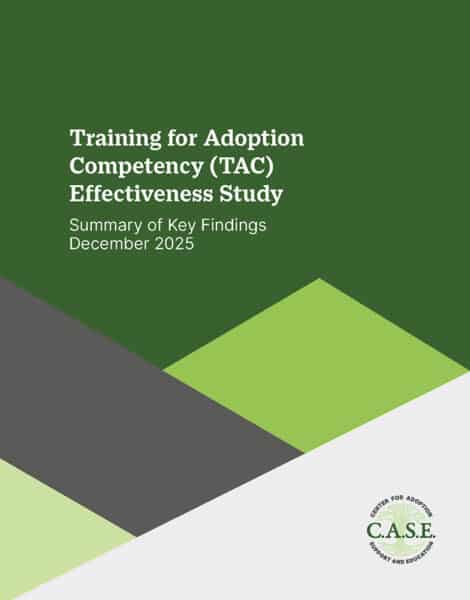
Cover image of C.A.S.E. The Training for Adoption Competency (TAC) Effectiveness Study

Training for Adoption Competency (TAC) Effectiveness Study: Summary of Key Findings December 2025


Building Access Through Partnership: Centene Invests in Illinois TAC Cohort for 2026

Building Access Through Partnership: Centene Invests in Illinois TAC Cohort for 2026

Building Access Through Partnership: Centene Invests in Illinois TAC Cohort for 2026


The National Center for Adoption Competent Mental Health Services is proud to partner with Centene to facilitate a Training for Adoption Competency (TAC) cohort in Illinois in 2026 which will launch in April 2026.  TAC is the nation’s premiere assessment-based certificate program for training mental health practitioners and developing adoption competency skills. Through classroom and remote instruction, as well as clinical case consultation, TAC students master key clinical skills that support adopted children and their foster, adoptive and kinship families.   

Centene Corp. LogoCentene’s investment in TAC is well-timed. The Center for Adoption Support and Education (C.A.S.E.) released two landmark research reports in December 2025 that provide the strongest evidence to date that adoption-competent mental health services deliver measurably better outcomes for adoptive families—and that far too few families can access them. 


“Birth parents, adoptive parents, adoptees, and kinship caregivers—engage in mental health services at rates 2.5 to 3 times higher than the general U.S. population.”


The new data, collected through a nationwide survey and a multi-state effectiveness study, show that families who engaged with TAC-trained clinicians—clinicians who have completed C.A.S.E.’s rigorous evidence-based, accredited Training for Adoption Competency (TAC) program—report stronger therapeutic alliances, higher satisfaction across all dimensions of treatment, more adoption-relevant care, and improved family outcomes. 

At the same time, the national survey reveals that families across the adoption kinship network—including birth parents, adoptive parents, adoptees, and kinship caregivers—engage in mental health services at rates 2.5 to 3 times higher than the general U.S. population, but face significant barriers to adoption-competent care. Just 21.84% of respondents rated their clinicians as adoption competent, with adoptees facing the steepest access challenges.


Adoption Competent Resources,
Right to Your Inbox

Join our email list and receive resources, learning opportunities, and up-to-date highlights of our work.

Families First: Understanding Kinship Care  

Families First: Understanding Kinship Care  

Families First: Understanding Kinship Care  


One night, while relaxing at home, Kayla received a surprise call from child welfare. Her sister had been deemed unable to safely care for her three children due to untreated mental health challenges, substance abuse, and housing instability. Faced with the possibility that her nieces, aged 4 and 11, and her nephew, aged 9, would enter foster care with strangers or be separated from each other, Kayla made a life-altering decision: she stepped in. Driven by love and responsibility, Kayla became a full-time caregiver.  

Like many kinship caregivers, Kayla was unprepared for the realities of navigating court hearings, school enrollment, trauma-related behaviors, or the emotional challenge of explaining to children why they could no longer live with their mother. Kayla had no prior experience with the child welfare system and no roadmap for managing such a profound transition.  

What she did have was a strong, shared bond with the children and knowledge of their family history, routines, and cultural identity. She knew, no matter what, they could overcome obstacles as a family.  


The Power of Kinship Care 

According to the U.S. Office of Personnel Management, kinship care is defined as the full-time care, nurturing, and protection of children by relatives or individuals with a significant familial or cultural bond. According to the Kids Count Data Center, approximately 2.5 million children and youth are in kinship care arrangements.  

Unlike non-relative foster care or adoption, kinship care allows a child to remain in a familiar environment, fostering a greater sense of identity and belonging, maintaining familial, cultural, and community connections, and increasing the likelihood that siblings will remain together. Kinship placements help minimize the trauma of being separated from their parents and preserve a sense of identity, all of which are beneficial mentally and emotionally. Research shows that children placed in kinship care experience greater placement stability and fewer behavioral challenges than those placed in non-relative foster care.  


Challenges in Kinship Care  

Although there is evidence that kinship care produces better behavioral outcomes for children and youth, many families do not receive the support and supervision that traditional foster and adoption families do. Kinship caregivers frequently fall through the cracks of traditional service systems. Common challenges include:  


        • Lack of training and preparation for guardianship 
        • Lack of knowledge of child welfare, education, and healthcare systems 
        • Lack of awareness of or access to support services 
        • Financial strain and limited access to resources 
        • Need for legal assistance
        • Caregiver stress, burnout, and secondary trauma 

 Caregivers like Kayla may not identify as foster or adoptive parents, but they shoulder the same responsibilities and emotional demands. 


Mental Health Needs in Kinship Care 

While children in kinship placements can experience better behavioral outcomes, they are not immune to the core issues that children and youth with child welfare experience, including complex trauma, ambiguous loss, grief, identity questions, and attachment disruptions. Whether a child is adopted by a relative, placed under guardianship, or raised informally by kin, they still have been separated from their biological family, which can create complex and layered mental health needs. In Kayla’s case, her nieces and nephew stayed with family. However, they still experienced profound loss due to separation from their parents, uncertainty about the future, and confusion about changing family roles.  


Adoption Competent Mental Health Care Matters in Kinship Care 

For child welfare professionals, supporting kinship families means understanding that placement stability alone does not guarantee healing. Adoption competent mental health services offer a vital framework for addressing the long-term emotional and relational needs of both children and caregivers involved in kinship care. 

When child welfare professionals intentionally connect kinship families to mental health services that can support permanency, they help ensure that families are not just keeping children safe but are also able to foster healing and growth. With over 20 years of experience providing adoption-competent care at C.A.S.E., we have seen firsthand how investing in adoption-competent, kinship-inclusive mental health care strengthens permanency, eases caregiver bu out, and supports lasting well-being for children and families. 


The National Center Supports Kinship Care 

The National Center for Adoption Competent Mental Health Services equips child welfare, mental health, and education professionals, as well as families, with the tools needed to recognize the unique intersections of trauma, loss, attachment, and family dynamics that arise in kinship placements. We also provide resources and support caregivers like Kayla by validating caregiver stress, strengthening caregiver-child relationships, and helping families navigate complex emotions without minimizing the child’s history or experiences. 


Looking for Additional Resources?

Visit the Knowledge Hub to access models of intervention, training resources, and practical tools to strengthen cross-system collaboration and improve outcomes for children, youth, and families.