
by Alisa Greenwood | Aug 30, 2024 | Access to Mental Health Services, Child Welfare Competent MH, For Professionals, Mental Health
This Week in the News 8/26-8/30
It was a busy news week for topics related to child welfare and mental health. We read a few articles centered on the continued discussion around the over-reliance of residential treatment, a key issue that many of our partners have identified as well. While we know children fare best with their family or in another home environment, it is often difficult to meet their mental health needs with community-based services. These states are identifying solutions and implementing new programs that can meet the child’s mental health needs in their community rather than a higher level of care:
- California continues to enact safeguards to ensure the safety of youth placed in residential treatment facilities. At the same time, they are taking steps to reduce the use of congregate care. Years ago, Califo ia shifted its approach from traditional group homes to address the longstanding issue of housing children solely due to the inability of local agencies to find more appropriate placements. Group homes are now used as short-term treatment programs. There are currently 339 such programs licensed in Califo ia, serving 1,499 youth, according to an Aug. 21 bill analysis. That number includes 1,182 foster youth and 317 children sent to a facility by a probation department.
- California parents of children on the Autism Spectrum also struggle with accessing mental health services and are often forced to place their child with the child welfare system. Despite the growing diagnosis of Autism, which has been estimated to affect more than 2 million children and teens across the country, experts and advocates have identified glaring gaps in services to meet the mental health needs of this population.
- Ohio is expanding its treatment foster care program, aimed at placing youth in family settings with caregivers trained to handle children facing behavioral, mental, or health challenges. This initiative enables children to remain within their local regions, near their families, schools, and healthcare providers. Additionally, specialized foster homes allow siblings to stay together. Recently, Ohio launched the Treatment Foster Home Pilot program across 34 participating counties grouped into 10 regions. This initiative is proving cost-effective for the state and counties, as treatment foster care costs significantly less — between one-third to one-fifth — compared to congregate care.
- Tulsa, Oklahoma has implemented the Mighty Makers program as a solution to meet the mental health needs of youth in the community. The program is designed to help children ages 5-12 effectively manage their emotions, with the support of their families. One of the standout features of the Mighty Makers program is its accessibility. The program is completely free, eliminating financial obstacles that often hinder families from seeking essential mental health support for their children.
In addition to covering the mental health needs of youth, recent headlines address the needs of both parents and the child welfare workforce who support children and youth:

by Alisa Greenwood | Aug 27, 2024 | Access to Mental Health Services, For Professionals, Mental Health
Rady Children’s Successfully Reduces Frequency of Emergency Mental Health Visits
Written by Erin Bader
A recent article has highlighted a California approach to meeting the mental health needs of children before they reach a crisis point. According to the article from the Chief Healthcare Executive, Rady Children Hospital in San Diego has seen a recent decrease in children coming into the Emergency Department for mental health needs after the hospital started placing mental health providers in primary care clinics. To date, Rady Children’s has seen a 40% reduction in mental health visits to the emergency department. The system has also reported a 44% decline in anxiety symptoms and a 62% drop in depression symptoms. “The difficult truth is that children and adolescents often do not receive mental health care when they need it,” Domonique Hensler, senior director of systemwide Care at Rady Children’s, and a co-author of the study, said in a statement. “The need for effective, accessible treatment is more pressing than ever,” Hensler said. “Our interdisciplinary, team-based approach to pediatric mental health care has been shown to be efficacious, accessible, and cost-effective.”
A recent Children’s Hospital Association survey found almost all pediatric hospitals (94%) said they have seen an increase in the number of children and teens requiring mental health services. More than half of children’s hospitals (58%) surveyed said they are conce ed about a lack of mental health resources to care for those patients. The number of young people visiting emergency departments for mental health reasons rose from 4.8 million in 2011 to 7.5 million in 2020, according to a study published by the Jou al of the American Medical Association.
The National Center can help your State, Tribe, or territory to build this type of cross-system collaboration through intensive technical assistance. To lea more about this practice and the research findings, you can read the full article on the Knowledge Hub.

by Alisa Greenwood | Aug 16, 2024 | Adoption Competent Services, For Professionals, Foster Care, Mental Health>self-care
As we dive into trauma-informed care this month at the National Center, we’re highlighting the importance of self-care in navigating and healing from past experiences. While self-care is vital for everyone, it can be an especially useful practice for those who have experienced trauma. At the National Center, we’re working to improve access to mental health services for children and families who have experienced the child welfare system. Self-care is an important piece of the mental health picture, and it can look different for everyone. We reached out to representatives from various groups in the mental health and child welfare systems to lea what self-care looks like for them.
Youth and young adults in child welfare
Victor Sim is a Lived Experience Leader with FosterClub, a National Center partner. As a guest on the Family Voices United podcast, he spoke about practicing self-care during a crisis. “I think it’s a huge struggle for a lot of people…you know we got a lot of people who are just dealing with that (recent events).” Victor recalls taking time for his mental health as a child in foster care. “I used to be really good at ‘slow down time’… I would listen to music in the moring and at night to slow myself down.” When asked about the advice he gives to others, he reminds listeners that, “It’s okay to know you’re not okay.”
Mental health workers
When we talk about mental health, it’s important to remember practitioners are people, too. They experience the effects of daily stressors and traumas like the rest of us. In fact, the demand for mental health services has increased dramatically since 2020. In a 2022 survey, 46% of mental health workers reported not being able to meet the demands of their increased workloads. Nearly half of the practitioners surveyed reported feeling bu ed out in 2022.  We asked Regi Corbi, a therapist at the Center for Adoption Support and Education (C.A.S.E.), how he practices self-care as a mental health worker in the years in the years since the Pandemic. “Some of my favorite ways to practice self-care as a therapist are physical exercise, yoga, or anything that can get my body moving.” Aside from exercise, Regi also gleans energy from art and community. “Listening to music, walking with my dog, and spending quality time with family and friends are the main ways I like to recharge, as well as getting a massage every now and then.”
Child Welfare Professionals
Similar to mental health workers, increased workloads, rising demands, and burnout are all too familiar to child welfare professionals. Erin Bader, Director of Knowledge and Dissemination at the National Center and former child welfare worker takes self-care seriously as she balances her life and passion for her work.  “Self-care is a necessity as a child welfare professional. I spend time with my husband, pup, family, and friends and always feel better.” It can be tough to find a balance between work and life, but Erin knows the importance of taking time to rest and unwind. “Work-life balance is a practice/way of life for me and allows me time to recharge my batteries so I can show up as my best self at work. This work matters too much for me not to be on my A-game. I also think that as helpers, it’s important for us to seek help too–therapy, journaling, support from loved ones.”
Families/Caregivers
 For families and caregivers in child welfare, practicing self-care can help to restore the energy needed to support those in need. Arnie Eby, foster and adoptive parent and Executive Director of the National Foster Parent Association (NFPA), a National Center partner organization, likes to take a moment each morning to look out the window and center his energy on something outside. “Focus time,” is Arnie’s way of tuning out the noise in life and grounding himself in the present moment. While these are all great examples of personal wellness, self-care is not one-size-fits-all, and it can look different for everyone. The important thing is to find out what works for you! How do you practice self-care?
For more information on trauma-informed care, check out some of these resources in our Knowledge Hub: Understanding Trauma-Informed Care to Build Parent Resilience Trauma Informed Parenting-Sequential Engagement Lived Experience (LEx) Leadership: Critical to Being Trauma Informed
by Alisa Greenwood | Aug 16, 2024 | Adoption Competent Services>Trauma-Informed Care, For Professionals, Foster Care, Lived Experience
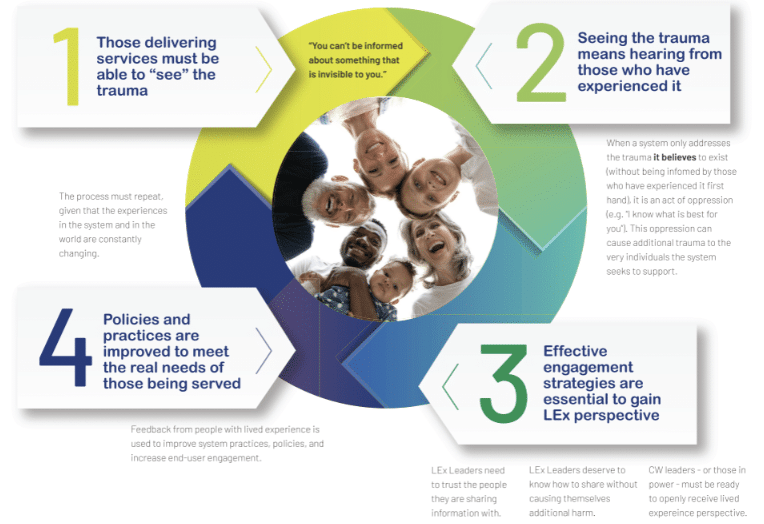
The National Center prioritizes the inclusion of lived experience voices in everything that we do. In order to improve mental health services for children and youth, we must all listen to and lea from those who have experienced child welfare and mental health systems. Binley Taylor worked with Faith Sharp, a LEx Leader, to write this post. To be truly trauma-informed, it is crucial for those delivering services to recognize and understand the trauma experienced by those they serve. This understanding is only possible by listening to the voices of people with lived experience (LEx). Seeing the trauma means hearing directly from those who have lived through it.
Faith Sharp, an individual with lived experience in foster care, highlights what makes someone with such a background a good leader. She emphasizes the importance of being flexible, working towards goals, and keeping track of one’s ideas. Faith feels empowered when adult stakeholders listen to her ideas and experiences. She believes that often her insights offer a unique perspective that others may not have considered, and it’s rewarding when her experience can blend into the work. As she continues to grow as a professional, she hopes to be heard not just as someone with lived experience but also as an expert in the workforce.
For LEx leaders to be willing to share their trauma, three key conditions must be met: Trust: LEx individuals need to trust the people they are sharing information with. Safety: They deserve to know how to share without causing themselves additional harm. Readiness: Child welfare leaders, or those in power, must be ready to receive this information, embracing power-sharing and other LEx engagement strategies. Faith shares that in her current work, she is part of changing the foster care system in small ways every day. Sharing her story is a significant part of this work. She advises adult stakeholders to avoid calling out youth in meetings but instead to create spaces for them to provide feedback. “Every room is a space for lived experience voice if you have a desire to include it,” she says. Tokenistically including LEx voices without genuine engagement contradicts the essence of meaningful inclusion. Effective engagement strategies are essential for meaningful participation.
Here are some key strategies to ensure effective engagement of LEx leaders : Create Safe Spaces: Ensure environments are supportive and non-judgmental. Provide Training: Equip LEx leaders with skills and knowledge. Offer Compensation: Recognize their contributions with fair compensation. Youth/Adult Partnerships: Encourage partnerships between LEx leaders and professionals. Continuously Seek Feedback: Use feedback to improve engagement and system practices. Policies and practices need to be improved to meet the needs of those served. This means adopting trauma-informed practices that truly understand and address the experiences of LEx individuals. By listening to and incorporating the voices of LEx leaders, the foster care system can make significant strides toward better outcomes for all. Faith’s jou ey and insights remind us that the inclusion of lived experience voices should be genuine and integrated into every aspect of the system. This approach not only enriches the work being done but also empowers those with lived experience to lead and innovate within the system.